MHz frequencies (~50 & ~150 MHz)
LOFAR
My team and I use LOFAR surveys to search for transient and variable sources on a range of timescales. Predominantly, we use the LOFAR Two-meter Sky Survey (LoTSS, Shimwell et al. 2017, 2019, 2022). LoTSS aims to survey the whole Northern Sky in 8 hour observations and we search within these data for transient and variable sources using a range of techniques. In the era of LOFAR2.0, we aim to automatically search all survey observations for transient and variable sources via the LORAX (proposal led by Rowlinson with an international team of experts).
Key results from my team include:
- Transient study using LoTSS – framework development and preliminary results (de Ruiter, Meyers, Rowlinson et al. 2023)
- A search for transient and variable sources on years timescales by comparing the LoTSS second data release to the TGSS conducted using GMRT. (de Ruiter, Leseigneur, Rowlinson et al. 2021)
AARTFAAC
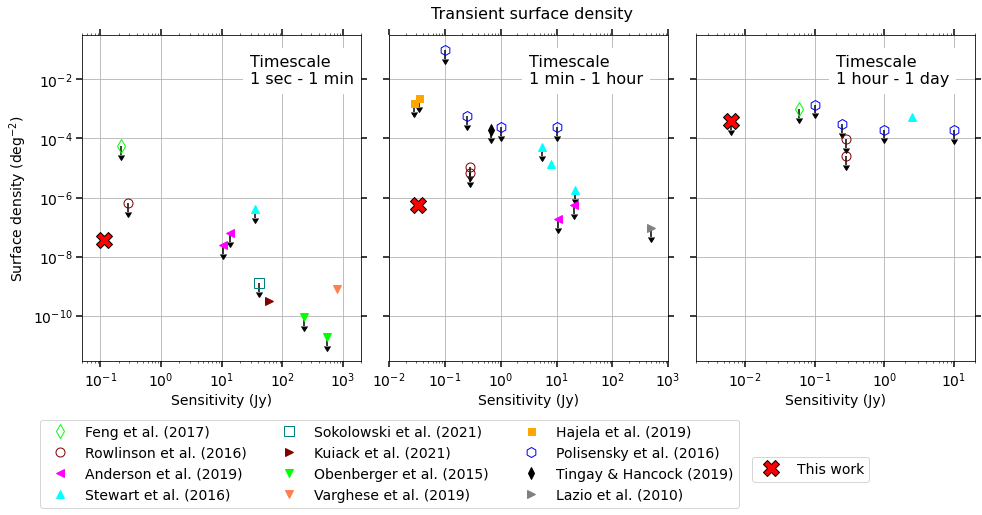
We have built a whole visible sky monitor using the central stations of LOFAR, known as AARTFAAC (Amsterdam ASTRON Radio Transients Facility And Analysis Centre, PI: Ralph Wijers). AARTFAAC piggybacks on standard LOFAR LBA observations and can make an image of the visible radio sky at ~50 MHz every second with a bandwidth of 3 MHz. With 6 LOFAR stations, we have achieved real-time calibration and imaging. Work is ongoing to extend the real-time calibration and imaging to use 12 LOFAR stations.
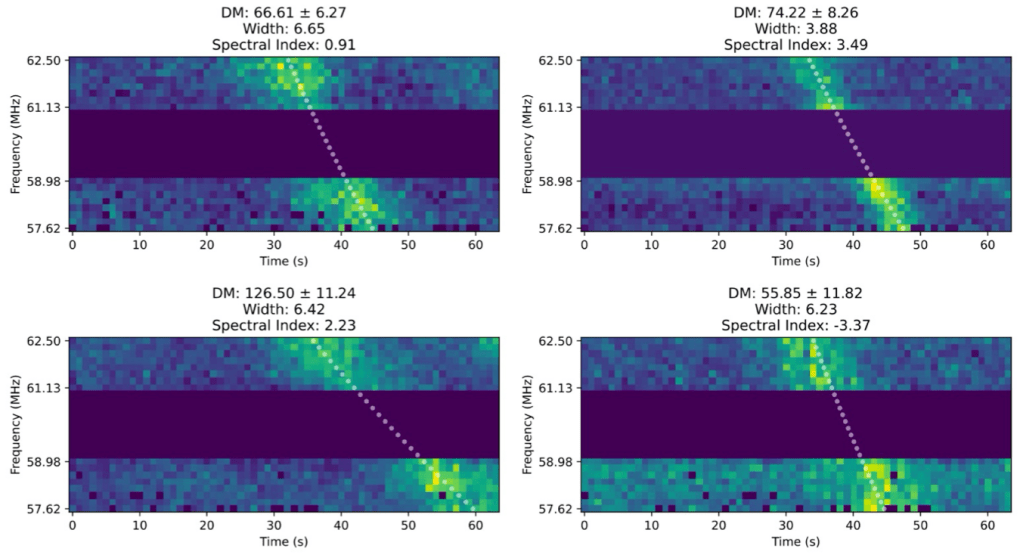
We have detected an unusual group of dispersed radio transients with AARTFAAC (see figure). Analysis of these sources is ongoing.
We have an AARTFAAC YouTube account where you can watch past observations using the innermost 6 LOFAR stations.
Key results from our team include:
- A tool to search for dispersed radio transients in AARTFAAC data (Ruhe et al. 2022)
- A search for transient sources on 1 second timescales using AARTFAAC (Kuiack et al. 2021a)
- Apparent radio transients mapping the near-Earth plasma environment (Kuiack et al. 2021b)
- A study of giant pulses from PSR B0950+08 (Kuiack et al. 2020)
- A catalogue of the Northern Sky by AARTFAAC (Kuiack et al. 2019)
GHz frequencies (~1.4 GHz)
MeerKAT
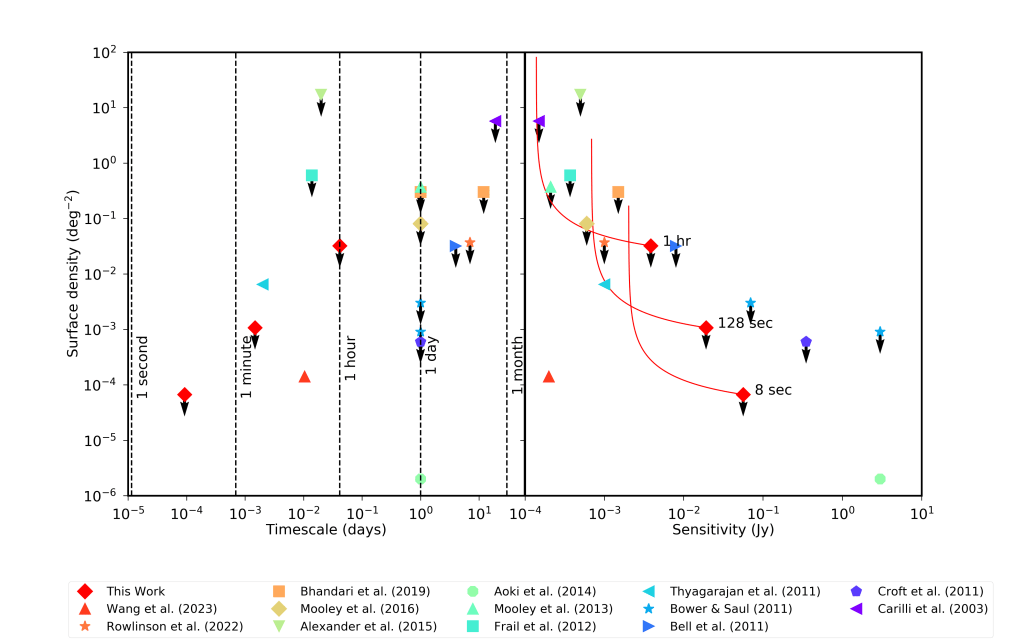
Working with the ThunderKAT team, I co-lead the commensal transient searches using MeerKAT survey data. Key results from my team include:
- A new method for short-duration transient detection in radio images: searching for transient sources in MeerKAT data of NGC 5068 (Fijma, Rowlinson et al. 2024)
- Commensal transient searches in eight short gamma-ray burst fields (Chastain, van der Horst, Rowlinson et al. 2023)
- Search and identification of transient and variable radio sources using MeerKAT observations: a case study on the MAXI J1820+070 field (Rowlinson et al. 2022)
 Antonia Rowlinson Personal Website